Bill Finley questions whether Paco Lopez is judged too harshly at Saratoga
Paco Lopez's Saratoga spill revived a bigger question: does his history drive harsher punishment than the video supports? The answer shapes trust in racing officiating.
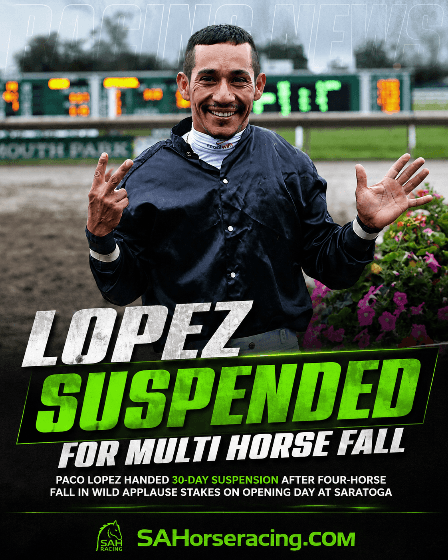
Paco Lopez got the 30-day suspension, but the argument around him is bigger than one rough ride at Saratoga. Bill Finley’s question cuts straight to racing’s credibility: when a jockey already carries a long disciplinary record, does every new controversy get judged on the evidence, or on the baggage?
The Saratoga spill that put Lopez back at the center
The flashpoint came in the July 3, 2026 Wild Applause Stakes at Saratoga Race Course, a one-mile inner-turf listed stakes for sophomore fillies with a $150,000 purse. In the stretch, I Love Giraffes became part of a four-horse spill that immediately turned a routine summer stakes into a rules case with race-day consequences. The New York Gaming Commission suspended Lopez for 30 days and labeled the offense “gross careless riding,” then Lopez appealed and received a stay.
The chart recap from Equibase matters because it shows how quickly a turf accident can become a chain reaction rather than a single-rider event. I Love Giraffes bumped with Pillar of Beauty’s hindquarters, clipped heels near the quarter-pole and fell, setting off the spill from there. That sequence is exactly why the case has stayed live: the incident happened in motion, at speed, with multiple horses involved and only split-second decisions to untangle afterward.
The aftermath was not abstract. I Love Giraffes later was reported to have suffered a broken hip. Javier Castellano was transported to Saratoga Hospital for further evaluation and x-rays, while Dylan Davis took off the rest of his mounts out of caution. Tyler Gaffalione, Davis and Lopez each walked off the course under their own power, which underscored how violent the spill looked even before the official ruling landed.
Why Lopez's record changes the temperature
No one has to pretend Lopez is a clean sheet. His history is the reason this debate has teeth, and the record is ugly enough on its own. HISA provisionally suspended him on Dec. 4, 2024 after the Parx postrace crop strike involving National Law, then conditionally reinstated him on Jan. 23, 2025. That reinstatement did not last: HISA suspended him for six months effective Sept. 23, 2025 after determining he violated the terms of the conditional return.
The whip record only deepened the problem. A later report said Lopez had 22 whip violations since HISA’s Racetrack Safety Program began in July 2022. That number does not excuse anything at Saratoga, but it explains why every new ruling involving Lopez arrives with a heavier dose of skepticism, and why his name has become part of the discussion before the stewards even finish writing.
That is where Finley’s point lands. The central issue is not whether Lopez has been disciplined before. It is whether those prior discipline cases are quietly becoming a shortcut for judging the current one. In a sport built on split-second calls, the standard has to be the evidence in front of the stewards, not a cumulative reputation file.
The video, the replay, and the blame problem
Finley’s most important argument is that the available video does not clearly prove deliberate wrongdoing. In a chain-reaction spill like this, outside viewers often want a simple villain, but the replay does not always cooperate. The first hit, the heel clip, and the fall all happen in a compressed sequence, which makes it hard to assign full blame from the grandstand, the couch, or even a looping replay.
Trainer Chad Summers sharpened that uncertainty by suggesting the replay made it look as though Junior Alvarado may have initiated the sequence, while Lopez ended up absorbing the punishment. That does not clear Lopez. It does, however, expose the central accountability problem: when one rider is already known to the regulators, does the stewards’ lens become narrower for him than for the rest of the room?
That is the tension Finley is pressing on. Lopez has unquestionably brought scrutiny on himself through repeated rule problems, especially involving the crop, but that does not automatically prove every close-call spill should end with the harshest reading of the facts. Racing loses trust when reputation starts to substitute for proof.
What makes the Saratoga ruling different
The New York Gaming Commission’s 30-day suspension is not just another note in a disciplinary file. It sits inside a larger pattern in which Lopez has already been through provisional suspension, reinstatement, and a separate six-month HISA penalty. That history makes the latest call feel less like an isolated judgment and more like a referendum on how racing disciplines repeat offenders.
The difficult part is that the Saratoga spill does not present the kind of clean, one-rider case that makes enforcement easy. If the replay is ambiguous and the incident was truly a chain reaction, then the rulebook has to work the same way for Lopez that it would for any other rider. If not, the sport is no longer punishing conduct alone. It is punishing identity.
That is where consistency becomes more than a talking point for horsemen and bettors. Fans need to believe the official result comes from the ride itself. Horsemen need to know the penalty that follows a spill is tied to what happened in the race, not what happened in the last one. Bettors need stable expectations about how stewards will interpret contact, interference and careless riding when stakes are high.
Why NYRA's transparency push matters here
NYRA has taken a meaningful step by putting stewards on camera and maintaining a Saratoga stewards page with written explanations for inquiries and objections. That does not make every call right, and it does not settle the Lopez question by itself. It does, though, give the sport a better way to explain why one rider was singled out and another was not.
That kind of transparency matters most in controversial races like the Wild Applause Stakes, where the public sees the spill first and the logic later. When the reasoning is posted directly after a decision, the sport at least creates a record that can be tested against the replay, the chart, and the rule language. In a case where Lopez’s name already primes the reaction, that record is essential.
The bigger lesson is simple: racing cannot ask for trust while leaning on memory more than evidence. Lopez’s history is real, the Saratoga spill was real, and the penalties were real. The question Finley raises is whether the sport can still separate those facts cleanly enough to prove the rules apply the same way to everyone.
This article was produced by Prism’s automated news system from verified source data, official records, and press releases, then run through automated quality and moderation checks before publishing. The system is built and supervised by the people who set the standards it runs under. Read our full AI policy.
Did this article answer your question?