Book'em Danno eyes Breeders' Cup Sprint in Mr. Prospector test
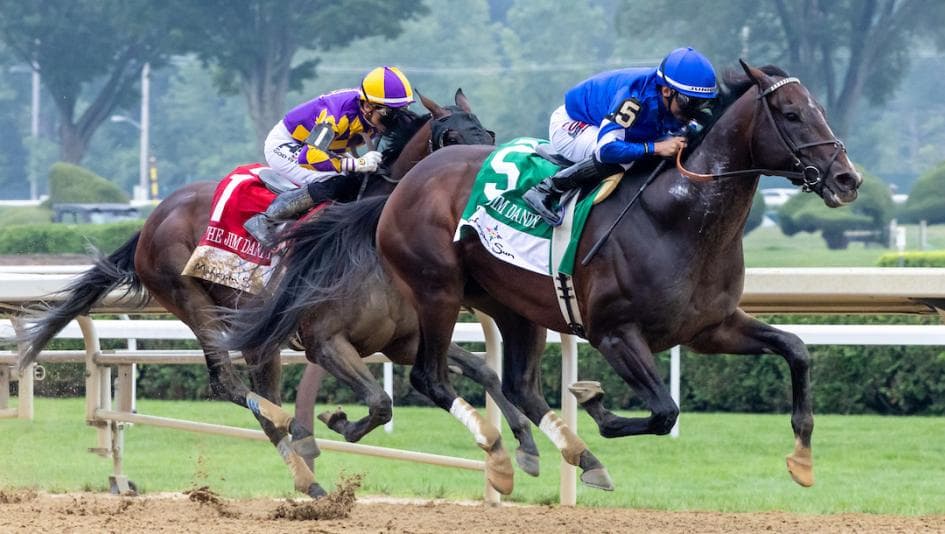
Book'em Danno passed the Mr. Prospector test at Monmouth and kept his Breeders' Cup Sprint path clean. The reigning sprint champ is now 12-for-19 with $2.2 million in earnings.

Book'em Danno answered the Mr. Prospector with the kind of performance that keeps a championship campaign on schedule. He won the $200,000 stakes at Monmouth Park on July 17, then left the race with a record that reads 12 wins from 19 starts and earnings of $2.2 million.
What the Mr. Prospector said about the horse
This was more than a local win for a New Jersey-bred Bucchero gelding trained by Derek Ryan and ridden by Paco Lopez. Book'em Danno came into the race already carrying the weight of being the reigning male sprint champion and the 2025 champion sprinter, so the question was not whether he belonged in the division conversation. The real question was whether he still looked like a horse moving toward a bigger autumn goal, or just a horse cashing in on reputation.
The answer was in the way he handled the setup. A race like the Mr. Prospector at Monmouth is supposed to expose any softness in a top sprinter's game, especially when the field has enough depth to force real pace pressure. Book'em Danno did not need a soft spot to keep his footing, and that matters more than the final margin on a résumé already filled with graded wins and stakes hardware.
Before the Mr. Prospector, his record stood at 11 wins from 18 starts, with nine stakes victories and five graded stakes wins. That is not the profile of a horse learning the game. It is the profile of a confirmed division player, and the Monmouth result simply added another line to a campaign that has been pointed upward for a long time.
Why this was a checkpoint, not just a prep
The race mattered because the long-range target is the 2026 Breeders' Cup World Championships at Keeneland in Lexington, Kentucky, on Oct. 30-31. The Breeders' Cup Sprint is set as a $2 million race for horses 3 years old and older, and that price tag is not just financial window dressing. It is the championship that gives every midsummer sprint in this division its context.
That is why the Mr. Prospector had to be read as a checkpoint. Ryan had already been managing Book'em Danno with restraint, with a June 2025 report saying he was aiming the horse sparingly toward a second Eclipse Award. That kind of campaign plan means every start has to pull double duty: stay sharp now, save enough for later. The Mr. Prospector fit that mold because it asked for a serious effort without draining the tank of a horse still being built toward October.
There is also the physical side of the story. A July 2026 preview noted that Ryan said the horse had gotten bigger, and that detail matters in sprint racing because muscle, frame, and body development can show up in the way a horse holds form through a summer campaign. A sprinter that keeps maturing while still producing elite results is the sort of horse you can map to a championship target with some confidence.
The eight-rival field made it a real test
The July 13 preview called for Book'em Danno to take on eight rivals in the Mr. Prospector, and that depth is what kept this from being a routine walkover. In sprint races, a crowded field changes everything: the first quarter can get hot, the trip can get messy, and the favorite does not get to loaf through any part of the run.
That is especially important when the horse in question is the one everyone is trying to beat. The deeper the field, the more likely pace pressure becomes the deciding factor, and the more valuable a clean trip becomes for bettors. In that sense, the race functioned as both a quality check and a market test, because a champion sprinter has to prove he can absorb attention, traffic, and pace chaos without losing his edge.
The field also sharpened the comparison between Book'em Danno and the rest of the division. A horse with 11 wins from 18 starts, nine stakes wins, and five graded stakes wins does not need to dominate every rival by daylight to validate his status. He needs to keep showing he can handle the best available competition without regression, and the Mr. Prospector gave him exactly that kind of assignment.
Why Monmouth made the story feel bigger
Book'em Danno's win carried extra weight because Monmouth Park had its own stake in the outcome. He is a New Jersey-bred horse, and the race gave the home crowd a chance to see one of the state's most accomplished active runners deliver on familiar ground. Monmouth promoted the race as a chance for his 12th career win, and he delivered on that expectation in front of the people who have followed his rise.
That local angle does not shrink the national one. It sharpens it. A horse that can dominate the conversation in New Jersey while still being pointed at Keeneland in the fall has the kind of campaign architecture that good connections want: stay home, stay sharp, and still stay relevant to the sport's biggest sprint stage.
The post-race numbers back up the trajectory. A horse who goes from 11-for-18 to 12-for-19 while stepping through a $200,000 stakes and adding to $2.2 million in earnings is not merely maintaining form. He is preserving a championship-level profile while the calendar turns toward the Breeders' Cup.
What this means for the sprint division
Book'em Danno is not chasing a generic stakes cycle. He is being managed like a horse with a defined target, and the Mr. Prospector was useful because it asked the right question at the right time: is he still a horse you trust in a championship sprint? Winning the race against eight rivals says yes.
The next stage is not about proving he belongs in the division. He already does. It is about whether the same horse who handled Monmouth in July can carry that edge into Keeneland in late October, where the Breeders' Cup Sprint will demand a different kind of sharpness and a much bigger stage. If the Mr. Prospector was the checkpoint, Book'em Danno cleared it cleanly.
This article was produced by Prism’s automated news system from verified source data, official records, and press releases, then run through automated quality and moderation checks before publishing. The system is built and supervised by the people who set the standards it runs under. Read our full AI policy.
Did this article answer your question?