Jockey Club reports second-lowest fatal injury rate in 2023 horse racing
The Jockey Club said 2023 fatal injuries fell to 1.32 per 1,000 starts, the second-lowest rate since 2009. The database shows the trendline, but not a single cause.
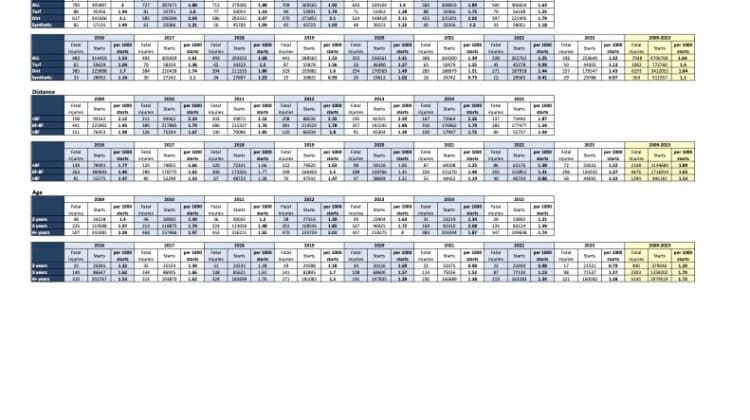
The Jockey Club said North American Thoroughbred racing logged 1.32 fatal injuries per 1,000 starts in 2023, the second-lowest rate since the Equine Injury Database began in 2009. The figure came from the database’s 15th year of reporting and followed 2022’s record low of 1.25 per 1,000 starts, a 5.6% increase that still kept the sport near the bottom of the EID’s history.
That long record is the point. The Equine Injury Database is the Thoroughbred industry’s first national database of racing injuries, built to quantify and compare safety over time instead of letting the discussion rest on individual breakdowns. The system was first proposed at the Welfare and Safety of the Racehorse Summit in October 2006, then launched in July 2008 after a 13-month pilot program that recorded more than 3,000 injury reports.
The strength of the EID is its denominator. A raw injury count can move up or down with race volume and field size, but a rate per 1,000 starts gives regulators, racetracks, veterinarians and horsemen a common benchmark. The Jockey Club said participating racetracks and associations voluntarily provide the statistics, and the database is funded entirely by The Jockey Club through InCompass Solutions Inc. and The Jockey Club Technology Services Inc., with the software module for participation offered free to racetracks, racing organizations and training centers.

The supplemental tables make the database more useful than a single headline number. They break out fatal injury data by surface, including dirt, turf and synthetic, as well as by age and distance categories. That is where the EID can point to trendlines and risk patterns, but it still cannot by itself explain every change in the numbers. A lower rate can reflect a mix of surface decisions, veterinary protocols, medication rules, workout monitoring and race-day management, and the database alone does not isolate one cause.
The 2023 reading also sat inside a broader safety push that has expanded beyond the Jockey Club’s long-running system. The Horseracing Integrity and Safety Authority released its inaugural annual metrics report on April 3, 2024, and later said the racing-related fatality rate at HISA racetracks fell below 1.00 per 1,000 starts in 2024 for the first time in recorded U.S. data. That gives the sport two measurement layers now, but the EID remains the baseline record that has tracked racing safety through more than a decade and a half of starts, surfaces and reforms.
This article was produced by Prism’s automated news system from verified source data, official records, and press releases, then run through automated quality and moderation checks before publishing. The system is built and supervised by the people who set the standards it runs under. Read our full AI policy.
Did this article answer your question?