Triple Crown tests the best 3-year-old Thoroughbreds over five weeks
The Triple Crown squeezes three races for 3-year-old Thoroughbreds into five punishing weeks, and that schedule is why so few horses survive it.

The Triple Crown is easy to name and brutally hard to finish. Three races for 3-year-old Thoroughbreds, the Kentucky Derby, Preakness Stakes and Belmont Stakes, are packed into a tight spring sequence that leaves little room for recovery and turns one brilliant run into a five-week test of speed, stamina and durability.
Why the sequence breaks so many champions
The order matters as much as the prestige. The Kentucky Derby is the first jewel, the Preakness comes next, and the Belmont closes the series, which means a horse has to keep improving while facing the best of its generation again and again. Kentucky Derby history materials frame that stretch as a demanding five weeks, and that compressed calendar is the real reason the sweep is so rare.
A horse that wins the Derby has already run 1 1/4 miles at Churchill Downs in a crowded field, then has to come back quickly for the shorter Preakness before stretching out again for the Belmont’s classic stamina test. That combination asks for early speed, recovery, and the ability to hold form under pressure, all within a month and change. In modern racing, where campaigns are often built around careful spacing, that kind of sequence is a stress test no other American series matches.
The three races that define the challenge
Each leg rewards a different quality, and together they create the sport’s hardest developmental exam. The Derby asks a 3-year-old to handle traffic and pace in the most famous starting point of the season. The Preakness often comes before any horse has truly reset, and the Belmont traditionally stretches the same generation to its limit.
That is why horsemen map out spring around these dates long before the gates open. A colt may be good enough to win one of the races on talent alone, but the Triple Crown demands that the horse stay sharp through changing distances and rapid turnaround. The series is not just three trophies on a shelf; it is a campaign structure that exposes which horses can keep getting better when the calendar is working against them.
The Belmont is where the test becomes pure stamina
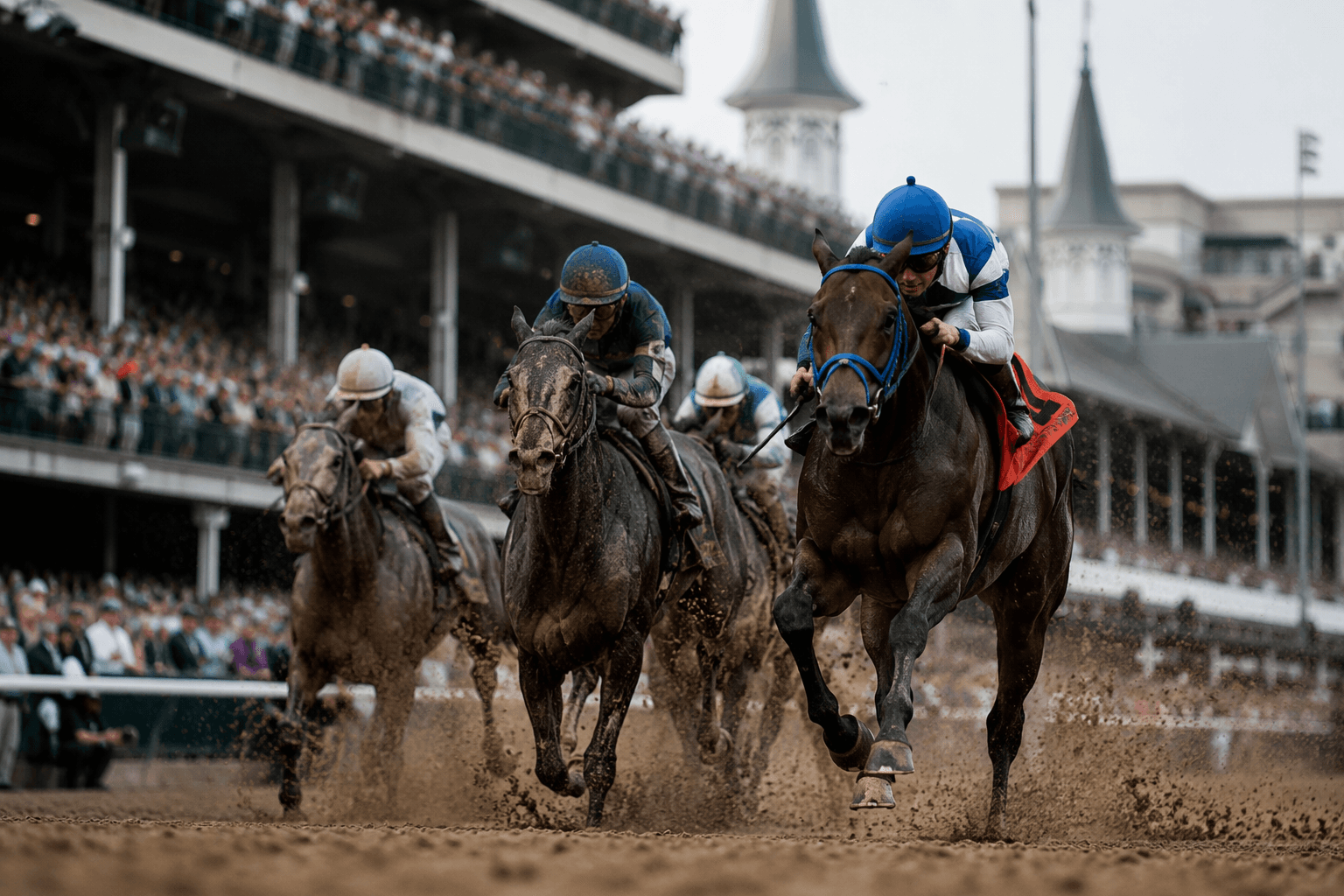
The Belmont Stakes site calls its race the final and most demanding leg of the Triple Crown, and the track’s history reinforces that place in the sport. The Belmont has been run at Jerome Park from 1867 to 1889, at Morris Park from 1890 to 1904, and at Aqueduct from 1963 to 1967 before settling into its modern identity at Belmont Park.
Distance is the reason the Belmont changes the equation. It is the traditional 1 1/2-mile stamina test, and Secretariat’s 1973 victory in 2:24 for the mile-and-a-half on dirt remains a world record cited by the Belmont Stakes site. After the Derby and Preakness have already asked for speed and resilience, the Belmont demands that a horse still has more left when the others start to fade.
A short list that still defines the sport
Only 13 horses have won the U.S. Triple Crown, which is why the phrase still carries such weight in a sport that stages races every day. The first was Sir Barton in 1919, and the list now includes Gallant Fox, Whirlaway, Citation, Assault, Count Fleet, Secretariat, Seattle Slew, Affirmed, American Pharoah and Justify.
That scarcity is what gives every spring its tension. Even elite horses often look like they are on the right path after the Derby, then the Preakness and Belmont expose how narrow the margin really is. American Pharoah ended a 37-year drought in 2015, and Justify became racing’s 13th Triple Crown winner on June 9, 2018, when he won the Belmont Stakes at Belmont Park by 1 3/4 lengths over Gronkowski.
Why modern campaigns make the sweep even harder
The Triple Crown is not only a test of raw talent. It is a test of how a stable plans a horse’s spring, how quickly a colt rebounds, and how confidently a rider can ask for another peak effort after the first one has already paid off. Modern campaign management usually prizes patience, which makes the Triple Crown’s old-school structure feel even harsher against today’s approach to development.
That is why the series remains the sport’s most recognizable benchmark for the best 3-year-old Thoroughbred in training. The horses are all the same age, so the races are supposed to measure one class against itself at the highest level. When a horse survives Derby traffic, the Preakness turnaround and the Belmont distance in one sweep, the accomplishment reads less like a season and more like a proof of power, endurance and timing.
Why the mythology still holds
The Triple Crown sits at the center of racing because it is simple to explain and nearly impossible to complete. Three races. One age group. Five demanding weeks. The formula has barely changed, but the challenge remains unforgiving because every leg strips away another layer of margin.
That is the appeal heading into every Triple Crown season. Fans know the names, the sequence and the stakes, but the schedule keeps reminding the sport that brilliance alone is not enough. To win all three, a horse has to arrive healthy, handle the pressure, recover fast and keep delivering when the calendar says it should already be out of fuel.
This article was produced by Prism’s automated news system from verified source data, official records, and press releases, then run through automated quality and moderation checks before publishing. The system is built and supervised by the people who set the standards it runs under. Read our full AI policy.
Did this article answer your question?